 "I wanted to be like the synth guy in dance hall music, the guy who has the gun shots and the wind sound and stuff." --Andrew Whiteman.
 I recently got to sit down with Andrew Whiteman, the man behind Apostle of Hustle when their tour came through Philadelphia this past June. We talk about their new album Eats Darkness, recording for Broken Social Scene and backing a Haitian Vodou Master drummer.
Listen below:
____________________________________________________________
Full text of the interview:
(my questions are bolded)
You’ve played with Broken Social Scene and you have Apostle of Hustle, and I think one of the differences between Broken Social Scene and this band is, with Apostle of Hustle, you incorporate a lot of eclectic influences, particularly a lot of world music and Cuban music. Where does that influence come from?
I just—I really like non-English speaking music. I get bored very easily, I'm very restless. So, I think that's why. I'm always looking for something shiny, something sparkly.
How do you think Apostle of Hustle and you as a musician has progressed from your first album, Folkloric Feel, up until the present?
Musically, it's looking like we're starting to figure out what our band is. Like, if you pick a band, the first band that comes to my mind—Camera Obscura, for example. You know that band?
Yeah.
Scottish pop band, right? I'm pretty sure from the outset those guys knew what kind of band they were. They knew what music they were going for. It's a very specific genre-type thing. It's Scottish, mordantly black humor. There's a whole tradition of that with...who am I thinking of? Not Belle and Sebastian but...Arab Strap! That's it. It's kind of like dark Scottish humor, funny thing, but then add some Phil Spector and a little 60's girl group vibe. Basically, they know what they're doing, they know what their music is and they know where it comes from, and a lot of bands are like that. The Black Lips, they play updated garage rock, amazing band.
My band, Apostle of Hustle, we don't know what we are. We don't know what we're doing. We slowly find out but it's a long experiment. I think we've definitely grown as musicians and in terms of how to approach what we're doing, we're getting a little bit more fluid at congealing all the flavors that enter the song so that, in a sense, what we're doing is, we're closer to actually having our own genre. We're closer than we were before.
Do you think that's partly your goal, to have your own genre?
[laughing] I don't think so, man, because it's not good for the bank book, but I can't really help it. It goes the way it goes and I don't really ask questions. If you're sitting around and music comes to you or words come to you, you can't ask too many questions or the muse won't function anymore.
I'd like to just get your thoughts a little bit on the new album Eats Darkness. What are some of the themes that run throughout that album?
Well, conflict is the main theme that runs through that. Battling...battles...different types of battles, you know?
I know you have one song called How to Defeat...
A More Powerful Enemy.
...A More Powerful Enemy.
Yeah. Well, there you go right there. That song is based on a news item from a long way back, from the Ollie North days. The idea of pamphlets being dumped out of a low-flying plane over a city and falling like snow, and all these pamphlets give you instructions how to blow up a hotel, slash tires, make a Molotov cocktail, you know what I mean? Guerilla war techniques with no language so you don't have to be able to read in order to follow these instructions. So, that's kind of that idea.
"Perfect Fit" is one I wanted to talk about.
Yeah.
There's a lot of interesting word play going on in that. You talk about fitting in, you talk about themes between life and death. What is the idea behind that song?
"Perfect Fit?"
Yeah.
In terms of the concept of the record, it fits because, well, I read that before Dakota Sioux Indians—I guess maybe Indians in general but I know Sioux Indians specifically because I was a big fan of Crazy Horse when I was a kid—and before you go into battle, you say, "It's a good day to die." You make peace with death before you go into the battle in case you're gonna go.
[rapping] "Cause you never know when you're gonna go. Life's a bitch and then you die," right?
[loud train passes by] Oh, on cue, right?
Of course.
Of course. That's Nas, man, he's listening. So, "Perfect Fit" is a death song. It's a song where you contemplate death before you go into battle.
 Another question I had about that song is about the music that accompanies it. I know listening to your past albums, this song in particular finds you using a lot of different instrumentation.
A lot of that’s Julian freaking out, playing bass and weird registers. Julian Brown is like a bag of tricks that nobody knows, so I can’t even explain. The only thing that I played on that song was synthesizer. I wanted to be like the synth guy in dance hall music, the guy who has the gun shots and the wind sound and stuff. So, I did that. And the song came up from a vocal loop. I was just fooling around with a looper pedal on my vocals and came up with a little pattern, and the whole song kind of came from that one little seed.
Another song that I wanted to ask about the music was the title track. Sometimes when you look to the title track of an album, that can give you a clue as to what the album’s about, but the song "Eats Darkness" is just this real spacey, psychedelic music. What was some of the stuff you did for that?
Musically?
Yeah.
You know, there’s a whole different version of that. There’s a whole different version of all those songs, but there’s a version of "Eats Darkness" that was—I had just bought an SP1200, an old vintage drum machine, so I had made some beats on that with these floppy disk sounds and built the song on that, and the chords. But that really wasn’t working. We tried doing a few different versions of it but it really wasn’t working. So, Dean came up with some patterns he did on the cajón. So, the percussion is the cajón but treated through a bunch of crazy effects, and we just stripped it right away. And it actually has a whole set of lyrics, which we’re like, “no, it needs breath, the record needs breath.”
That song itself, you could look at it as a metaphor for Eats Darkness because it’s all calm, the false front of calm, calmness and serenity. And by the time you get to the end, the electronic, distorted drums kick in and there’s a way-atonal guitar solo at the end. So, it’s like the transformation.
Is that the theme for the title Eats Darkness, a kind of serenity overcoming the bad?
No, I wouldn’t say it’s overcoming. It’s transformative. It’s alchemical. It’s the idea of the poison is the antidote. You must consume some of the poison in order to rid yourself of the poison. That’s what the record’s really about.
You have a bunch of interesting interludes on the album. I especially like the introduction one.
Yeah!
Did you get all those from one source?
No, no, no, no, no. I had such a good time doing that. I thought I was just gonna do—because when I realized it was a battle record, I said, “Oh, I’m gonna do dance hall and have a bunch of gun shots and stuff in between all the songs.” So, I started collecting stuff, and then when I actually started doing them, I loved doing it. I got poetry, sound effects, just anything I could grab off the web or off anywhere. A lot of the music is just little stoner jams that I’ve done over the past 10 years, just little pieces of them.
Each of those pieces is designed to be in front of the song that it’s in front of. There are clues about the song that follows in the song in front of it. And there’s actually four more, but the record company decided it was a little too much to have one in between every single song. It got too much for people. And also, I had to redo things because I stole stuff from places where I’m not supposed to steal it, and it would have been way too obvious and they would have sued us, and my record company wasn’t having that. So, I had to re-record a bunch of things too because HBO wouldn’t like that.
Yeah, sometimes real life gets in the way.
Mmmhmm.
Last question I had about the new album is about the cover art. I like the picture on the front with the…
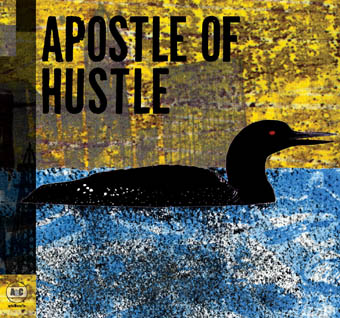 Loon.
Loon.
It’s a loon?
Yeah, it’s Canadian.
Who did that?
A friend of ours. He’s a poet and a book designer in Toronto named Mark Goldstein. We gave him the concept and he went for it.
I really like that.
Yeah, thanks. I’m happy with that too.
So, you’re in the middle of the tour now, how is it going?
It’s going OK. We would be going way harder but my other job is calling me. Social Scene’s doing a lot of recording now and is quite busy, so I can’t really take off with this for too long. So, we’re doing just a little run, hit Chicago, New York, Washington, here—Philly—and go home. Like I said, we’re a band that’s very restless. It takes us time to settle into our thing. I think we’re just starting to feel out the new songs and God knows where it’s gonna go. I don’t know.
You just mentioned that Broken Social Scene is recording right now, is that for an up-coming album?
Yeah. Well, we did a week—well, I had to leave because I had a gig, I mean I had an Apostle tour, so I had to leave. But I think it was a total of two and a half weeks in Chicago with John McEntire and then, we have a next phase coming up in another week or two, another six days down there. It’s bits and pieces but, yeah, it’ll come out next year, all things…
[knocks on table] If it goes well, it’ll come out next year.
Cool, definitely look for that.
Yeah, yeah, yeah.
As for Apostle of Hustle, any plans in the immediate future?
Yeah. Well, when Broken Social Scene goes hard, I can’t tour with Apostle, I can’t do much. So, starting in the late fall and then next year, I’m gonna be more viral. I have a DVD I’m working on. It’s like a stoner cabaret DVD based on a poem of Ezra Pound that we recorded last year. Hopefully like a Zappa-type stoner movie. If I can get cartoons in it, I absolutely will. So, I gotta work on that. That should be ready pretty soon.
Also, Apostle, we recorded a record in March. Three days live off the floor with a Haitian Vodou singer and master drummer. His name’s Jean-Baptiste Bonga. That should come out next year, too, Apostle backing up a Vodou Master.
Very cool. Is that a live album?
Well, it won’t be live but, yeah, we recorded everything live and it’ll get all chopped up. Julian’s actually gonna go do some of that in a couple of weeks.
Is there anything else you want to mention?
No, but thank you for listening, though. I appreciate attention to detail.
 Apostle of Hustle mix things up with a stripped-down performance of
"National Anthem of Nowhere" at their June 11th show
at the Kung Fu Necktie in Philadelphia, PA.
Related Links:
Apostle of Hustle: Official Site
Broken Social Scene: Official Site
Arts & Crafts Records: Official Site


 Posts
Posts


No comments:
Post a Comment